Translate This Page

Showing posts with label native plants. Show all posts

Sunday, April 12, 2015


the long cast shadows of early Spring and the old and diseased main trunk of the White Pine, Pinus alba, the Iroquois "Tree of Peace", that was taken down by the electric company as a threat to wires and driveway at my daughter and son-in-law's home. I'll incorporate some its' sawdust to artwork honoring its' long life. there was not enough resin to take for binder with pigments at the cuts and signified the dried state of the tree. this photo sketch also aligned with a trip with my daughter and grandchildren to the New York State Museum where several permanently installed life size dioramas and wall displays of early native Iroquois arts, life and traditions exist. enThanks...


~the two headed~

Tuesday, December 24, 2013


"flaked paint installation with Clover sp leaf"
Be Well with a strong Heart, Voice and...

~as we step into the gateway of expanded consciousness with lightness of being~ 
Red Clover Trifolium pratense transforms the lower chakras, Root/Red..  
2nd/Sacral/Orange Chakra combine the Red and Yellow flowers
Yellow Clover Melilotus off. addresses the Solar or 3rd Chakra. 
the leaves of all Clover sp address the Heart Chakra/Green and the Blue/Throat Chakra. 
Violet/3rd Eye we claim by combining the red flower with the blue colors of the leaf. 
White Clover Trifolium repens brings us to our heightened awareness of Spirituality above our bodies physicality.... 
within a more intimate observation of each; Red, Yellow and White of the Clover' florets
we note a spectrum of colors. As guidance; with Red Clover at the base of each floret emerges the sepal tints green, then white, possibly some yellow then red, blue and violet. With White Clover begins green, often then white etc. There are often orange hues with Yellow Clover. Generally all the color' hues of the flower, and its' auras, will run with a full spectrum of colors.
The laying of "flaked paint" acknowledges, aligns and accents
the healing vibrations with the Clover and with them/us...

Saturday, November 16, 2013


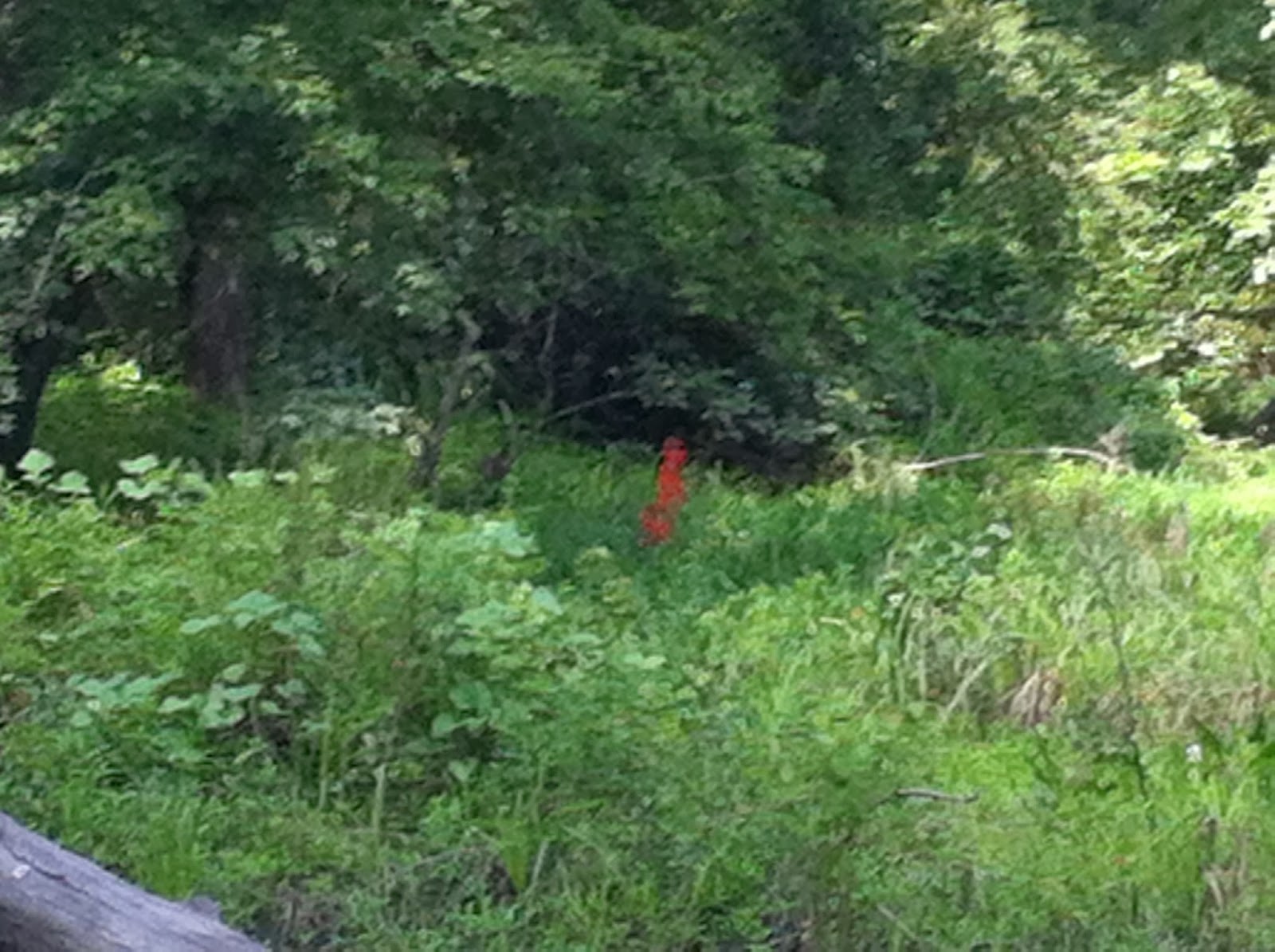
"Cardinal Flower"

am liking the pareidolia of
this painterly shot in Turners Falls, MA 

Cardinal flower is not typically in regular use in herbal medicine Lobelia inflata is. Lobelia cardinalis possesses less potency as an analgesic, antispasmodic, emetic and cartarrh with bronchial respiratory and lower digestive systems.

I took near where a camp of Native Americans...

from http://en.wikipedia.org/wiki/King_Philip's_War
"May 18, 1676, Captain William Turner of the Massachusetts Militia and a group of about 150 militia volunteers (mostly minimally trained farmers) attacked a large fishing camp of Native Americans at Peskeopscut on the Connecticut River (now called Turners Falls, Massachusetts). The colonists claimed they killed 100–200 Native Americans in retaliation for earlier Indian attacks against Deerfield and other colonist settlements and the colonial losses in the Battle of Bloody Brook. Turner and nearly 40 of the militia were killed during the return from the falls."

As it was at fishing camps just before sunrise the men were all out fishing. The camp of over 200 elders, women and children were slaughtered,was atop the cliffs that dropped down to the rapids of the river. Below the men listened to the screams.. These lands were Sacred as fishing and farming along the Connecticut. Healing intent with this photo is to send a message of recognition, understanding and consciousness into the Earth of the people...
~Love, Peace and CoCreativity~

Wednesday, September 11, 2013


am calling this one "shingle grid shadow". it's part of the processing with the "shingle grid" series posted in late July/13;
http://gregpatch.blogspot.com/2013/07/blog-post_26.html
http://gregpatch.blogspot.com/2013/07/blog-post_27.html
http://gregpatch.blogspot.com/2013/07/blog-post_28.html
while the shingle/moss/lichen piece sat on the mossy and lichened picnic table it gathered more of its defining characteristics it left its imprint on the table.
here Sun light and shadow created this "negative" image. this shot was taken after a rain, as one of the many rains this summer had just ended. will take a comparative shot as things dry out and will post...

Sunday, August 11, 2013

I like to watch the fifth season theory, Lammas. This year’s early August Summer storm front signaled the change as storms often do. High winds, some rumbles and lots of rain. Two nights down into the 40 and 50s. We are in a new season. The grains, Winter Squashes and beans are ready for harvest. The length of the day is a bit more noticeably shorter as the angle of the Sun lessens and the colors change.
Here in the Northeast the greens change to the metallic Copper, Zinc Brassy, and Copper Tin Bronzy tonalities. The Amber grains and a full spectrum of beans. There are deeper darks with contrasting light colors of the Sun as its light refracts and reflects differently now as it spends more time during the day shining through the lower atmospheres.

I was having fun writing this and then it struck me, “with very fine heavy metal particles floating around in our atmosphere how does that effect the colors of the season?” – one of those deeper darker spaces!
This is the first piece of "the fifth season" Series or "toilet paper series" with more in the studio... 

the fifth season, Lammas

Earth oxide and oxate pigments
Pine Pinus alba resin & inclusions
egg yolk
citrus solv®
toilet paper
Khadi paper


Wednesday, August 7, 2013

Tuesday, August 6, 2013

Monday, August 5, 2013

Thursday, August 1, 2013


"center ring 46"

Earth oxate, ochre pigment & wheat paste installed with repurposed wood post

Wednesday, July 31, 2013


"center ring 45"

Earth oxate, ochre pigment & wheat paste installed with repurposed wood post

Tuesday, July 30, 2013


"center ring 44"

Earth oxate, ochre pigment & wheat paste installed with repurposed wood post

Monday, July 29, 2013


"center ring 43"

Earth oxate, ochre pigment & wheat paste installed with repurposed wood post


Wednesday, July 17, 2013

 "Dandelion 1"

 "Dandelion 2"

                                                    
"Dandelion 3"


3 stages of drying Dandelion leaf and root photosketched. At three separate drying stages I moved plant material to air the process, preventing mold and to prevent plant material sticking to the wood surface. Each reset becomes an art work and photographed as lightness and movement in relation to each other...

Thursday, June 27, 2013

Sun Flower, Pyramid and the Tree of Peace
gifted with this photo sketch this morning off my back porch as Sun rose behind the elder White Pine at the edge of the forest of Beartown State Park...  

a second version...
Sun Flower, Pyramid and the Tree of Peace #2

Friday, May 10, 2013

Mullein


mulleinfrom http://www.pfaf.org/user/Plant.aspx?LatinName=Verbascum+thapsus

"Verbascum thapsus - L.             
Plants For A Future can not take any responsibility for any adverse effects from the use of plants. 
Always seek advice from a professional before using a plant medicinally.

Anodyne;  Antiseptic;  Astringent;  Demulcent;  Emollient;  Expectorant;  Homeopathy;  Narcotic

 Odontalgic;  Vulnerary.

Great mullein is a commonly used domestic herbal remedy, valued for its efficacy in the treatment of pectoral complaints[4]. 

It acts by reducing the formation of mucus and stimulating the coughing up of phlegm, and is a specific treatment for 
tracheitis and bronchitis[254]. The leaves and the flowers are anodyne, anti-inflammatory, antiseptic, antispasmodic, 
astringent, demulcent, diuretic, emollient, expectorant and vulnerary[4, 7, 13, 21, 46, 53, 165, 222]. An infusion is taken 
e (Thymus vulgaris)[254]. Externally, a poultice of the leaves is a good healer of wounds and is also applied to ulcers,
 tumours and piles[4, 222, 254]. Any preparation made from the leaves needs to be carefully strained in order to remove the 
small hairs which can be an irritant[7]. The plant is harvested when in flower and is dried for later use[238]. An infusion of 
the flowers in olive oil is used as earache drops, or as a local application in the treatment of piles and other mucous 
membrane inflammations[4, 222, 238].
This infusion is also strongly bactericidal[4]. A decoction of the roots is said to alleviate toothache and also relieve cramps 
and convulsions[4]. The juice of the plant and powder made from the dried roots is said to quickly remove rough warts when 
rubbed on them[4]. It is not thought to be so useful for smooth warts[4]. The seeds are slightly narcotic and also contain 
saponins[4]. A poultice made from the seeds and leaves is used to draw out splinters[4]. A decoction of the seeds is used 
to soothe chilblains and chapped skin[7]. A homeopathic remedy is made from the fresh leaves[4]. It is used in the treatment 
of long-standing headaches accompanied with oppression of the ear[4].
Other Uses
Dye;  Insecticide;  Insulation;  Lighting;  Tinder;  Wick.

A yellow dye is obtained from the flowers by boiling them in water[4]. When used with dilute sulphuric acid they produce a rather 

permanent green dye, this becomes brown with the addition of alkalis[4, 13, 100, 168]. An infusion of the flowers is sometimes 
used to dye the hair a golden colour[4, 200]. The flowering stems can be dipped in wax and used as torches[53, 106, 124]. The 
down on the leaves and stems makes an excellent tinder when quite dry[4, 53, 115]. It is also used as an insulation in shoes to keep 
the feet warm[4, 200] and to make wicks for candle[1, 4, 13, 100, 115, 124]. One report says that the leaves contain rotenone, 
though it does not say in what quantity[222]. Rotenone is used as an insecticide[K]."


Thursday, April 25, 2013

Yellow Thistle Cirsium horridulum


This Yellow Thistle was in a colony of about 20 plants at the edge of an inland water salt marsh in Wilmington NC. The flower was 5" in diameter and the plant stood about 6' tall. The stalk was nearly 3" in diameter.

from http://herb.umd.umich.edu/herb/search.pl?searchstring=Cirsium
Yellow Thistle; Asteraceae
Seminole Other (Hunting & Fishing Item)
Plant used to make blowgun darts.
Sturtevant, William 1954 The Mikasuki Seminole: Medical Beliefs and Practices. Yale University, PhD Thesis (p. 507)

Like all Cirsium thistles the leaf (remove the spiney edges), stalk and 
root are edible and a Spring liver cleansing bitter like Dandelion. The Latin horridulum relates to flatulent farting, drawing our own conclusions a tonic for gaseous conditions of the liver and digestive organs perhaps...


Traditional ethical wildcrafting & foraging is a sustainable practice. One does not gather every thing in sight as that leads to wiped out colonies of plant life that continue to produce and sustain their population by their natural seeding and/or root growth cycles. The general ethical natural code, universal law, is to gather no more than 10% to 25% of any colony so in the following years there'll be more or at least a constant population. Birds and other animal and plant life are also dependent on these food sources. Consider that 4 separate people unknowing of the others gather 25% in one season can occur without conscientious and mindful practices. Please respect where you gather. Toxic areas next to highways, airports and railways are poor selections. Always ask permission of the landowner. They can often tell you if someone else is gathering on their land or that they depend on the harvesting of the plant life. Also consider plant species that are already threatened or endangered by over harvesting and not wildcraft or support any one who does harvest Echinacea sp., Goldenseal and American Ginseng. Check for other plants that are threatened in the area. Contact groups like American Herbalists Guild and United Plant Savers who are active networking communities and have access to to this knowledge. And foremost, offer thanks and gratitude to the plants, they appreciate that.

Sunday, April 14, 2013

Many thanks to those who stopped in for the Open Studio Show yesterday!

Spiderwort as a food and a medicinal...
Spiderwort Tradescantia virginiana

from http://plants.usda.gov/plantguide/pdf/cs_trvi.pdf

"Alternate Names
Common spiderwort, dayflower, flower-of-a-day,
Job’s tears, snake-grass, spider-lily, trinity, trinitylily, widow’s-tears
Uses
Ethnobotanic: The Cherokee and other Native
American tribes used Virginia spiderwort for various
food and medicinal purposes. The young leaves were
eaten as salad greens or were mixed with other greens
and then either fried or boiled until tender. The plant
was mashed and rubbed onto insect bites to relieve
pain and itching. A paste, made from the mashed
roots, was used as a poultice to treat cancer. A tea
made from the plant was used as a laxative and to
treat stomachaches associated with overeating.
Virginia spiderwort was one of the seven ingredients
in a tea used to treat “female ailments or rupture.” It
was also combined with several other ingredients in a
medicine for kidney trouble."

and from www.eattheweeds.com/spiderwort-pocahontas-and-gamma-rays/


Stems can be cooked like asparagus
"in Florida, the height of its season is late in the spring but it also blossoms nearly all year, and more importantly, as it ages it does not grow rank. Its leaves do not change in flavor as the plant ages. The leaves are good for salads as well, or in soup and stews but they are mucilaginous. The stems can be braised like asparagus. Spiderwort remains a popular edible because they are one of the few salad greens that can take Florida’s summer heat. The flowers, at one time favorites for candying, make very pretty blue additions to back yard salads."
..."Oh, and the gamma rays… The cells of the stamen hairs of someTradescantia — the wispy hairs that look webesque when moist with dew — are “bioassays for ambient radiation levels.” Or said another way: The hairs are blue. When exposed to gamma radiation they turn pink. So if you think you’ve been near a nuclear explosion, just check your nearest Tradescantia."