Gathered Stinging Nettles Urtica dioica sp. on Solstice morning and here it is hanging briefly before I set in the darkness of a dry shed. In gathering I allowed it to sting me with its acidic virtues into a two day itch for my joints, bones and kidneys. The itch and swelling time can be an indication of ones' needs for the healing powers of this fine herb. I've had more intense reactions in previous years so I'm happily not scratching, grin...
The energetics of Summer Solstice and the perigee Full Moon in Capricorn instill me with Belief!, caring for others within the family circle and outward, and strengthening my own knees/needs...
One of my teachers and a good friend is Ryan Drum. Check out http://www.ryandrum.com/wildcrafting.htm to read his articles on wildcrafting Stinging Nettles and other medicinals.
environmental land artist collaborating with Earth pigments, plant materials, Earth elements and environmental energetics... please visit me with Facebook, https://www.facebook.com/gregpatch... all contributions are appreciated, visit and think about being a patron... www.Patreon.com/GregPatch with over 30 years experience I also offer wellness council with people and their diet/herbs, exercise and lifestyle choices... Thanks, and Be Well...
Translate This Page
Showing posts with label Diet. Show all posts
Monday, June 24, 2013
Labels:
art,
biodegradable,
Diet,
foraging,
green art,
healing,
herbs,
nature,
non toxic art,
plant medicine,
sustainable art,
whole foods,
wildcrafting
Friday, August 19, 2011
what does "how long did it take you to paint this" mean?
this stage of the painting is "about" 16 hrs of working the surface later than the last entry on it>>>
my mother used to tell my two brothers and I she wanted us to "sit enjoying the Sunday meal before us as long as it took her to prepare the meal". If she had said "as long as she spent enjoying preparing the meal before us" it may have had a different effect. She did tell us that because she worked all week and we were doing our thing it gave us the opportunity to catch up with each other. Meanwhile, "don't talk with your mouthful."
Labels:
art,
art blog,
beeswax and pigment,
being an artist,
Diet,
food in art,
green art,
grid,
Khadi,
sustainable,
symbolism,
webh
Monday, August 1, 2011
Lammas
from http://en.wikipedia.org/wiki/Lammas connect with Wikipedia to read more about the Lammas.
Other links :
www.asiya.org/sabbats/lammas.html
www.schooloftheseasons.com/lammas
www.mythinglinks.org/Lammas.html
www.lammas.org.uk/ - Describes a planned low-impact eco-village near Glandwr. Profile, proposal and how to become involved.
Lammas
From Wikipedia, the free encyclopedia
| | This article includes a list of references, related reading or external links, but its sources remain unclear because it lacks inline citations. Please improve this article by introducing more precise citations where appropriate. (July 2011) |
For the Norfolk village, see Lammas, Norfolk.
| Lammas also known as Lambess | |
|---|---|
| Observed by | England Scotland Pagans (Neo-pagans, Wiccans) Christians (Catholics, Anglicans) |
| Type | Cultural, Religious (Pagan, Christian) |
| Date | 1 August (northern hemisphere) 1 February (southern hemisphere) |
| Celebrations | Handfasting Funeral Games First Fruits |
| Observances | Loaves made from the grain collected at harvest. |
| Related to | Lughnasadh |
In mediæval times the feast was known as the "Gule of August", but the meaning of "gule" is unclear. Ronald Hutton suggests that it may be an Anglicisation of Gŵyl Awst, the Welsh name for August 1 meaning "feast of August", but this is perhaps an overly-complicated extraction. Most etymological dictionaries give it an origin similar to gullet; from O.Fr. goulet, dim. of goule "throat, neck," from L. gula "throat,". One can see why Hutton feels differently as this Welsh derivation would point to a pre-Christian origin for Lammas among the Anglo-Saxons and a link to the Gaelic festival of Lughnasadh.[citation needed]
There are several historical references to it being known as Lambess eve, such as 'Publications of the Scottish Historical Society' 1964 and this alternative name is the origin of the Lambess surname, just as Hallowmass and Christmas were also adopted as familial titles.
Contents[hide] |
Christian
The feast of St. Peter in Chains, known as Lammas Day in English speaking countries, is a feast commemorating St Peter's miraculous deliverance from prison. The name is from loaf-mass, bread-feast; so called because on this day offerings were originally made of the first-fruits of harvest, the Catholic church baptizing the pagan festival in the tradition of the Hebrew First Fruits.Pre-Industrial
In The Every-Day Book by William Hone (published: 1838), he speaks of a festival common among Scottish farmers near Edinburgh that happens on August 1, or "Lammas Day." He says that they "build towers...leaving a hole for a flag-pole in the center so that they may raise their colors." When the flags over the many peat-constructed towers were raised, farmers would go to others' towers and attempt to "level them to the ground." A successful attempt would bring great praise. However, people were allowed to defend their towers, and so everyone was provided with a "tooting-horn" to alert nearby country folk of the impending attack and the battle would turn into a "brawl." According to Hone, more than four people had died at this festival and many more were injured. At the day's end, races were held, with prizes given to the townspeople.Neo-Paganism
Lammas is a Neo-Pagan holiday, often called Lughnasadh, celebrating the first harvest and the reaping of grain. It is a cross-quarter holiday halfway between the Summer Solstice (Litha) and the Autumnal Equinox (Mabon). In the northern hemisphere, Lammas takes place around August 1 with the Sun near the midpoint of Leo in the tropical zodiac, while in the southern hemisphere Lammas is celebrated around February 1 with the Sun near the midpoint of Aquarius. On the Wheel of the Year, it is opposite Imbolc, which is celebrated on February 2 in the northern hemisphere, and late July / early August in the southern hemisphere.Other uses
Lammas is one of the Scottish quarter days.Lammas leaves or Lammas growth refers to a second crop of leaves produced in high summer by some species of trees in temperate countries to replace those lost to insect damage. They often differ slightly in shape, texture and/or hairiness from the earlier leaves.
See also
References
- The Stations of the Sun, Ronald Hutton, Oxford 1996
- (1.3.19),Romeo and Juliet, William Shakespeare, "Come Lammas Eve at night shall she [Juliet] be fourteen." Since Juliet was born Lammas eve, she came before the harvest festival, which is significant since her life ended before she could reap what she had sown and enjoy the bounty of the harvest, in this case full consummation and enjoyment of her love with Romeo.
- 'Publications of the Scottish Historical Society' 1964
External links
- Pretanic World Pre-Christian Holidays & Pre-Christian Traditions of Christian Holidays from Britain and Ireland
- Gule of August
- Observations on Popular Antiquities
Labels:
art,
astrology/astronomy,
balance,
Diet,
Environmental Art,
food in art,
healing,
herbs,
natural,
organic,
plant energetics,
sacred,
sustainable,
waves of grain,
whole foods
Wednesday, July 13, 2011
"...a progressing transformation..." note 15
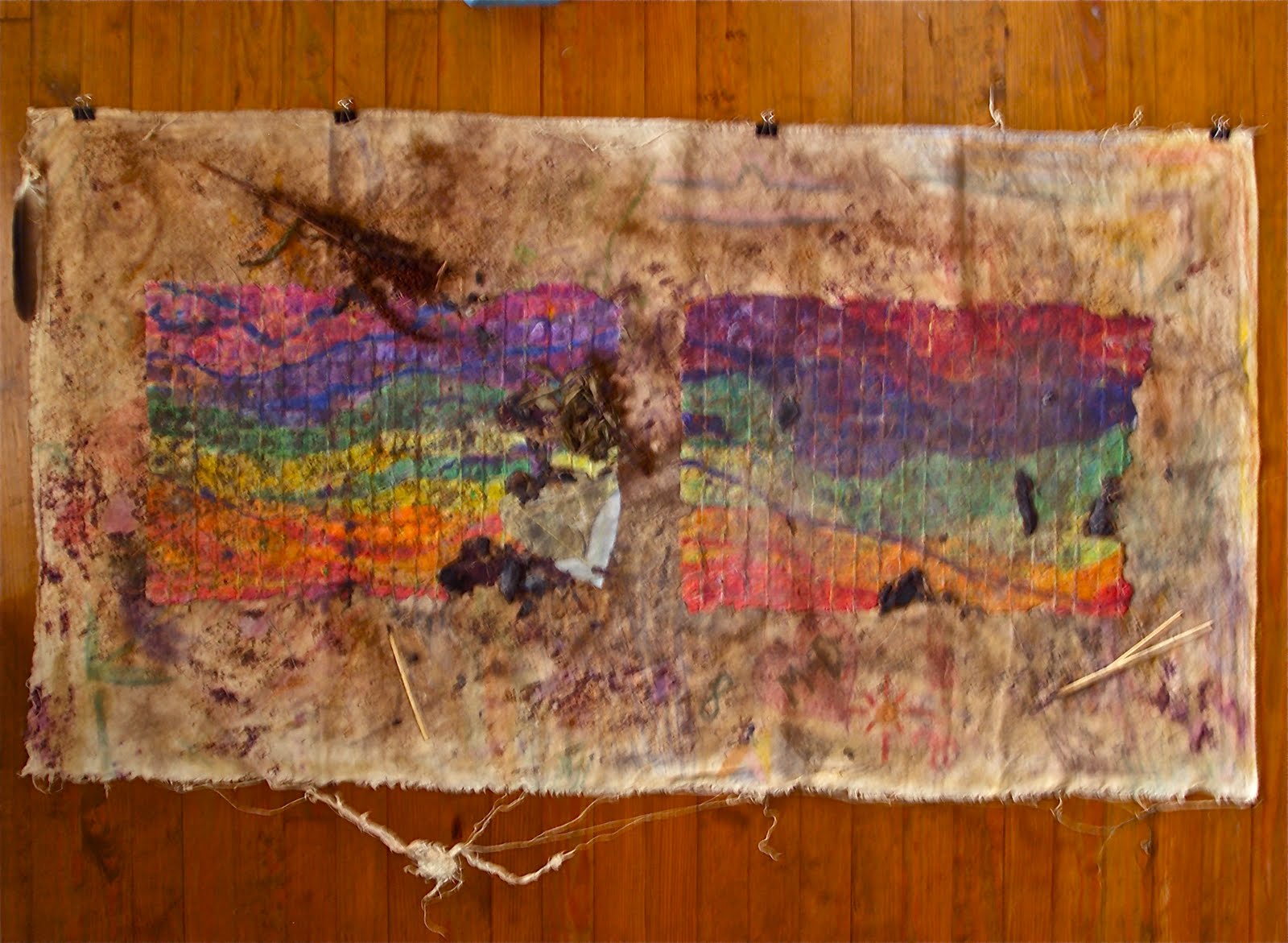
The dimensions of the piece is 47" x 73". Finer particles of ash, a couple more lighting sticks, perhaps some crayon, plant materials, etc aren't placed at this stage. Am working on the right combination of beeswax, sustainably harvested Dammar resin and solvent for an added an adherence and a preserving finish.
| The coals from the fire that were formed at this stage when the water from the rains fell. |
Elder Sambucus nigra from the land gifted us with leaf and stem. Later in the summer the bush will flower and its delicious berries and strong dye will appear. Elder is a powerful healer.
I highly recommend further reading from the sidebar on this blog in exploring Elder. In being aligned with Elder its energetics and medicine is gratefully accepted.
Below is from Wikipedia, http://en.wikipedia.org/wiki/Elder_tree
A 2001 study entitled "The effect of Sambucol, a black elderberry-based, natural product, on the production of human cytokines: I. Inflammatory cytokines" concluded: "We conclude from this study that, in addition to its antiviral properties, Sambucol Elderberry Extract and its formulations activate the healthy immune system by increasing inflammatory cytokine production. Sambucol might therefore be beneficial to the immune system activation and in the inflammatory process in healthy individuals or in patients with various diseases. Sambucol could also have an immunoprotective or immunostimulatory effect when administered to cancer or AIDS patients, in conjunction with chemotherapeutic or other treatments. In view of the increasing popularity of botanical supplements, such studies and investigations in vitro, in vivo and in clinical trials need to be developed."[10]
A Modern Herbal by Mrs. M. Grieve suggests several elderberry syrup recipes:[6]
- To make Elderberry Rob [syrup], 5 lb. of fresh ripe, crushed berries are simmered with 1 lb. of loaf sugar and the juice evaporated to the thickness of honey. It is cordial, aperient and diuretic. One or two tablespoonsful mixed with a tumblerful of hot water, taken at night, promotes perspiration and is demulcent to the chest. The Rob when made can be bottled and stored for the winter. Herbalists sell it ready for use.
- 'Syrup of Elderberries' is made as follows: Pick the berries when throughly ripe from the stalks and stew with a little water in a jar in the oven or pan. After straining, allow 1/2 oz. of whole ginger and 18 cloves to each gallon. Boil the ingredients an hour, strain again and bottle. The syrup is an excellent cure for a cold. To about a wineglassful of Elderberry syrup, add hot water, and if liked, sugar.
Toxicity
The leaves, twigs, branches, seeds and roots contain a cyanide producing glycoside. Ingesting any of these parts in sufficient quantity can cause a toxic build up of cyanide in the body. In addition, the unripened berry, flowers and "umbels" contain a toxic alkaloid.
Due to the possibility of cyanide poisoning, children should be discouraged from making whistles, slingshots or other toys from elderberry wood. In addition, "herbal teas" made with elderberry leaves (which contain cyanide inducing glycosides) should be treated with high caution. However, ripe berries (pulp and skin) are safe to eat.[13]
Ecology
The berries are a very valuable food resource for many birds. In Northern California elderberries are a favorite food for migrating Band-Tailed Pigeons. Flocks can strip an entire bush in less than an hour. Elders are used as food plants by the larvae of some Lepidoptera species including Brown-tail, Buff Ermine, Dot Moth, Emperor Moth, The Engrailed, Swallow-tailed Moth and The V-pug. The crushed foliage and immature fruit have a strong fetid smell.
Valley elderberry longhorn beetle in California are very often found around red or blue elderberry bushes. Females lay their eggs on the bark. Larvae hatch and burrow into the stems.
Dead elder wood is the preferred habitat of the mushroom Auricularia auricula-judae, also known as "Judas' ear fungus".[14]
Folklore
Folklore is extensive and can be wildly conflicting depending on region.
- In some areas the "elder tree" was supposed to ward off evil influence and give protection from witches, while other beliefs say that witches often congregate under the plant, especially when it is full of fruit.
- In some regions, superstition, religious belief, or tradition prohibits the cutting of certain trees for bonfires, most notably in Witchcraft customs the elderberry tree; "Elder be ye Lady's tree, burn it not or cursed ye'll be" – A rhyme from the Wiccan rede.
- If an elder tree was cut down, a spirit known as the Elder Mother would be released and take her revenge. The tree could only safely be cut while chanting a rhyme to the Elder Mother.[16]
Pop culture references
- The most powerful wand in the Wizarding World of Harry Potter is a wand made of sambucus known as the "Elder Wand".[17]
- In Monty Python and the Holy Grail, the keeper of the French castle taunts King Arthur and the Knights of the Round Table by telling them that "[their] Father smelt of elderberries."
The stalk and seed head of Yellow Dock Rumex crispus. The roots have also been used medicinally as an astringent, tonic, and laxative. Compounds contained in the plant's roots have been clinically verified to bind with heavy metals such as lead and arsenic and expel them from the body by stimulating biliary function in the liver. The plant is considered a highly effective blood cleanser and is used by herbalists to assist the body in eliminating heavy metals and to treat other hepatic disorders.
- http://en.wikipedia.org/wiki/Rumex_crispus (I've quoted wikipedia for my own convenience. Suggested reading is available; check my sidebar for my recommendations.)
Labels:
art,
Diet,
food as medicine,
food in art,
healing,
herbs,
LOVE/PEACE/COCREATIVITY,
native plants,
organic,
plant energetics,
sacred,
sustainable
Monday, July 11, 2011
Saturday, July 9, 2011
a weaver with its' webh
| a weaver with its webh 2011 ©Greg Patch |
This re minds me of a classic to understanding wholisitic medicine I was guided to read by my teachers early on in realizing my work as a wholistic herbalist/dietary counsel and as an artist. Ted Kaptchuk's "The Web That Has No Weaver" is an introductory connector in understanding the spirit of relationship of Western and Chinese natural medicines.
Sunday, July 3, 2011
Watermelon; food as medicine
| Seed in our fruits; think of sterility and add 1 + 1, or subtract. Life is in your power of choice. |
Watermelon
From Wikipedia, the free encyclopedia
Watermelon (Citrullus lanatus (Thunb.), family Cucurbitaceae) is a vine-like (scrambler and trailer) flowering plant originally from southern Africa. Its fruit, which is also called watermelon, is a special kind referred to by botanists as a pepo, a berry which has a thick rind (exocarp) and fleshy center (mesocarp and endocarp). Pepos are derived from an inferior ovary, and are characteristic of the Cucurbitaceae. The watermelon fruit, loosely considered a type of melon – although not in the genus Cucumis – has a smooth exterior rind (green, yellow and sometimes white) and a juicy, sweet interior flesh (usually pink, but sometimes orange, yellow, red and sometimes green if not ripe). It is also commonly used to make a variety of salads, most notably fruit salad.[1]
History
Watermelon is thought to have originated in southern Africa, where it is found growing wild, because it reaches maximum genetic diversity there, resulting in sweet, bland and bitter forms. Alphonse de Candolle, in 1882,[2] already considered the evidence sufficient to prove that watermelon was indigenous to tropical Africa.[3] Though Citrullus colocynthis is often considered to be a wild ancestor of watermelon and is now found native in north and west Africa, Fenny Dane and Jiarong Liu[4] suggest on the basis of chloroplast DNA investigations that the cultivated and wild watermelon appear to have diverged independently from a common ancestor, possibly C. ecirrhosus from Namibia.
It is not known when the plant was first cultivated, but Zohary and Hopf note evidence of its cultivation in the Nile Valley from at least as early as the second millennium BC. Although watermelon is not depicted in any Egyptian hieroglyphic text nor does any ancient writer mention it, finds of the characteristically large seed are reported in Twelfth dynasty sites; numerous watermelon seeds were recovered from the tomb of Pharaoh Tutankhamun.[5]
By the 10th century AD, watermelons were being cultivated in China, which is today the world's single largest watermelon producer. By the 13th century, Moorish invaders had introduced the fruit to Europe; according to John Mariani's The Dictionary of American Food and Drink, "watermelon" made its first appearance in an English dictionary in 1615.
Museums Online South Africa list watermelons as having been introduced to Native Americans in the 16th century. Early French explorers found Native Americans cultivating the fruit in the Mississippi Valley. Many sources list the watermelon as being introduced in Massachusetts as early as 1629. Southern food historian John Egerton has said he believes African slaves helped introduce the watermelon to the United States. Texas Agricultural Extension horticulturalist Jerry Parsons lists African slaves and European colonists as having distributed watermelons to many areas of the world. Parsons also mentions the crop being farmed by Native Americans in Florida (by 1664) and the Colorado River area (by 1799). Other early watermelon sightings include the Midwestern states (1673), Connecticut (1747) and the Illiana region (1822).
Charles Fredric Andrus, a horticulturist at the USDA Vegetable Breeding Laboratory in Charleston, South Carolina, set out to produce a disease-resistant and wilt-resistant watermelon. The result was "that gray melon from Charleston." Its oblong shape and hard rind made it easy to stack and ship. Its adaptability meant it could be grown over a wide geographical area. It produced high yields and was resistant to the most serious watermelon diseases: anthracnose and fusarium wilt.
Today, farmers in approximately 44 states in the U.S. grow watermelon commercially, and almost all these varieties have some Charleston Gray in their lineage. Georgia, Florida, Texas, California and Arizona are the USA's largest watermelon producers.
This now-common watermelon is often large enough that groceries often sell half or quarter melons. There are also some smaller, spherical varieties of watermelon, both red- and yellow-fleshed, sometimes called "icebox melons."
In Japan, farmers of the Zentsuji region found a way to grow cubic watermelons, by growing the fruits in glass boxes and letting them naturally assume the shape of the receptacle.[6] The square shape is designed to make the melons easier to stack and store, but the square watermelons are often more than double the price of normal ones. Pyramid shaped watermelons have also been developed and any polyhedral shape may potentially also be used.
Culture
For commercial plantings, one beehive per acre (4,000 m² per hive) is the minimum recommendation by the US Department of Agriculture for pollination of conventional, seeded varieties. Because seedless hybrids have sterile pollen, pollinizer rows of varieties with viable pollen must also be planted. Since the supply of viable pollen is reduced and pollination is much more critical in producing the seedless variety, the recommended number of hives per acre, or pollinator density, increases to three hives per acre (1,300 m² per hive).
Nutrition
Watermelon, raw (edible parts) | |
Nutritional value per 100 g (3.5 oz) | |
127 kJ (30 kcal) | |
7.55 g | |
- Sugars | 6.2 g |
0.4 g | |
0.15 g | |
0.61 g | |
91.45 g | |
Vitamin A equiv. | 28 μg (3%) |
0.033 mg (3%) | |
0.021 mg (1%) | |
0.178 mg (1%) | |
Pantothenic acid (B5) | 0.221 mg (4%) |
0.045 mg (3%) | |
Folate (Vit. B9) | 3 μg (1%) |
8.1 mg (14%) | |
7 mg (1%) | |
0.24 mg (2%) | |
10 mg (3%) | |
11 mg (2%) | |
112 mg (2%) | |
0.10 mg (1%) | |
Percentages are relative to US recommendations for adults. Source: USDA Nutrient database | |
A watermelon contains about 6% sugar and 92% water by weight.[7] As with many other fruits, it is a source of vitamin C.
The amino acid citrulline was first extracted from watermelon and analyzed.[8] Watermelons contain a significant amount of citrulline and after consumption of several kg, an elevated concentration is measured in the blood plasma; this could be mistaken for citrullinaemia or other urea cycle disorders.[9]
Watermelon rinds, usually a light green or white color, are also edible and contains many hidden nutrients that most people avoid eating due to its unappealing flavor. They are sometimes used as a vegetable.[10] In China, they are stir-fried, stewed or more often pickled. [11] When stir-fried, the de-skinned and de-fruited rind is cooked with olive oil, garlic, chili peppers, scallions, sugar and rum. Pickled watermelon rind is also commonly consumed in the Southern US.[12] Watermelon juice can also be made into wine.[13]
Watermelon is also mildly diuretic[14] and contains large amounts of beta carotene.[15] Watermelon with red flesh is a significant source of lycopene.
Varieties
There are more than 1200[16] varieties of watermelon ranging in size from less than a pound, to more than two hundred pounds, with flesh that is red, orange, yellow or white.[17] Several notable varieties are included here.
- Carolina Cross: This variety of watermelon produced the current world record watermelon weighing 262 pounds (119 kg). It has green skin, red flesh and commonly produces fruit between 65 and 150 pounds (29 and 68 kg). It takes about 90 days from planting to harvest.[18]
- Yellow Crimson Watermelon: variety of watermelon that has a yellow colored flesh. This particular type of watermelon has been described as "sweeter" and more "honey" flavored than the more popular red flesh watermelon.[19]
- Orangeglo: This variety has a very sweet orange pulp, and is a large oblong fruit weighing 9–14 kg (20–30 pounds). It has a light green rind with jagged dark green stripes. It takes about 90–100 days from planting to harvest.[20]
- The Moon and Stars variety of watermelon has been around since 1926.[21] The rind is purple/black and has many small yellow circles (stars) and one or two large yellow circles (moon). The melon weighs 9–23 kg (20–50 pounds).[22] The flesh is pink or red and has brown seeds. The foliage is also spotted. The time from planting to harvest is about 90 days.[23]
- Cream of Saskatchewan: This variety consists of small round fruits, around 25 cm (10 inches) in diameter. It has a quite thin, light green with dark green striped rind, with sweet white flesh and black seeds. It can grow well in cool climates. It was originally brought to Saskatchewan, Canada by Russian immigrants. These melons take 80–85 days from planting to harvest.[24]
- Melitopolski: This variety has small round fruits roughly 28–30 cm (11–12 inches) in diameter. It is an early ripening variety that originated from the Volga River region of Russia, an area known for cultivation of watermelons. The Melitopolski watermelons are seen piled high by vendors in Moscow in summer. This variety takes around 95 days from planting to harvest.[25]
- Densuke Watermelon: This variety has round fruit up to 25 lb (11 kg). The rind is black with no stripes or spots. It is only grown on the island of Hokkaido, Japan, where up to 10 000 watermelons are produced every year. In June 2008, one of the first harvested watermelons was sold at an auction for 650 000 yen (6300 USD), making the most expensive watermelon ever sold. The average selling price is generally around 25 000 yen (250 USD).[26]
Cultural use
In Vietnamese culture, watermelon seeds are consumed during the Vietnamese New Year's holiday, Tết, as a snack.[27]
- Stereotypical caricatures may depict African Americans as being inordinately fond of watermelon.[28]
- The Oklahoma State Senate passed a bill on 17 April 2007 declaring watermelon as the official state vegetable, with some controversy surrounding whether a watermelon is a fruit.[29]
- The citrulline which exists in watermelon (especially in the rind) is a known stimulator of nitric oxide. Nitric oxide is thought to relax and expand blood vessels, much like the erectile dysfunction drug Viagra, and may even increase libido.[30]
- Fans of the Saskatchewan Roughriders of the CFL started a tradition of hollowing out a watermelon and wearing it as a makeshift football helmet (the color of the Roughriders is green). During the 2009 Grey Cup in Calgary (between the Montreal Alouettes and the Roughriders), thousands of watermelons had to be imported to Calgary supermarkets to prevent a shortage being caused by Rider fans.[31]
- The town of Chinchilla in Queensland, Australia holds a biannual festival celebrating all things melon.
- The Ten-lined June beetle is often affectionately referred to as a Watermelon Beetle, due to the green, striped pattern on its back.
- It is the symbol of the Turkish city, Diyarbakır.
Labels:
art,
art blog,
Ayurveda,
color,
Diet,
food as medicine,
healing,
herbs,
native plants,
organic,
sacred,
sustainable art
Wednesday, June 29, 2011
Thankyou! Rain
we're 12" behind in rain for this year and getting a serious drizzle this morning. the critters & the plants are singing. there's a re lax a tion and re new all in the air!...
| Rising Tree Energies Embrace With Sinking Rain Energies ©Greg Patch |
Labels:
art,
Diet,
Environmental Art,
green art,
healing,
LIVE,
nature,
sacred,
sustainable,
sustainable art
Thursday, June 23, 2011
Wholistic Co-Creative Healing
a self/other cathartic writing of ...a processing transformation...
Moved this past winter in shifts, in a flash, drove to/from the northeast to visit family/friends and dropped from the ladder of the loft I was constructing. Was returning to my bed after taking a leak around 2:30AM am in the dark and the mattress I was gripped onto to pull myself up shifted. Letting go... and landed in a crouching position. One of my favorite yoga positions. The damage done. Acumulatively into the now with a sprained rt knee, strained right sacroilliac joint, stressed already stressed/never repaired dislocated left shoulder and severe bodily misalignment from compensating from the injuries had me down. Wholistic injury! Coming back up, leg stretches and twists are still shaky. Lots of stretching/restrengthening rehab to go and bionic dental surgery scheduled for the summer. Many thanks for all the wonderful support I have received from 2 amazing physical therapists, several Reiki practitioners, an acupuncturist for depression; compromised liver, a fantastic alignment masseuse, an Ayurvedic dietary & herbal counsel for my prostate cancer combined with my own herbal protocol, making art, astrology, 3 different restorative yoga instructors, all the many guides, friends and family (particularly some of my Mom's great genes and encouragement that keep me trucking on!) and my own persistence and still learning self love/respect and accepting myself as a spiritual being in a human body. Toward healing Wholisticly. Tomorrow will start seeing a Network Chiropractic for more continuous healing work - enThanks all!
Love/Peace/Co-Creativity in healing to I/WE/ALL.
Labels:
art,
Diet,
gravity,
healing,
herbs,
LOVE/PEACE/COCREATIVITY,
natural,
organic,
spiritual,
sustainable,
webh,
whole foods,
yoga
Tuesday, May 17, 2011
placed on display/sale Red Violet Wave &
Into Waves 6 at Carolyn Atkinson's Flying Pi Kitchen at 402 Chestnut in Wilmington, NC this morning with other art she has on display there. I got to meet Carolyn's artist sister Lisa and more of her friendly staff. A welcome in spot for a mix of good locally grown, organic and natural foods prepared with healthy intentions and open atmosphere.
Check their hours out on their Facebook page, or be spontaneous and stop in for breakfast or lunch for very tasty nourishment.
Labels:
art,
art blog,
beeswax and pigment,
being an artist,
Diet,
green art,
local,
natural,
non toxic art,
sacred,
sustainable art,
whole foods
Subscribe to:
Posts (Atom)