Translate This Page

Showing posts with label foraging. Show all posts

Monday, April 14, 2014


"Lunar eclipse"
charcoal

dual tasking project done this Spring. made my own charcoal drawing sticks and dried Weeping Willow bk Salix babylonica. White Willow Salix alba is typically used for both charcoal sticks and as a medicinal in Western herbalism. Salix spp have similar properties of varying amounts salicylic acid and other constituent properties. Linden Tilia grandifolia can also be used for making the sticks and is also a good herb used often in cardio applications medicinally where anxiety, insomnia and cold are symptomatic.


materials used:
2 cap steel pipe (@$6 for this 6" pipe/caps) will last for many years of use and comes in lengths up to many feet)
green Willow Salix babylonica branch
fire/hot coals

- strip bark from green 1/4" - 1+" long cut branch of Willow. (give thanks to the tree spirit, Earth, and the elements, and your own abilities!)
- set bark strips on metal screen, cotton cheesecloth to dry in airy, warm, dark space to dry. place in airtight glass tightly capped jar for storage in dark, cool space.
- place green sticks inside pipe available at hardware, electrical supply stores or metal junk yards. screw caps on to air tight the container and place in wood stove, kiln, yard fire or barbecue, etc. and allow to cook for 5 -12 hrs. remove when cooled or with prongs to set aside and cool. remove sticks and
- enjoy your new art supply and medicinal.

cost for my small bounty of sticks cooked inside 6" pipe runs anywhere from $8 - $10 retail.

Willow bark is a good anti inflammatory though not for all constitutions. it is cooling and Turmeric, for instance, would be a better application with Vata and some Pita Doshas and with situations where inflammation is caused by cold conditions like chillblain or Chillblain Lupus.
here's one good medicinal informational link for Salix;
http://www.backtothelandnaturalfoods.com/ns/DisplayMonograph.asp?storeID=8277E28769C14CACAFA69116098EDF57&DocID=bottomline-willowbar
*always consult with a knowledgeable health care professional


Saturday, November 16, 2013


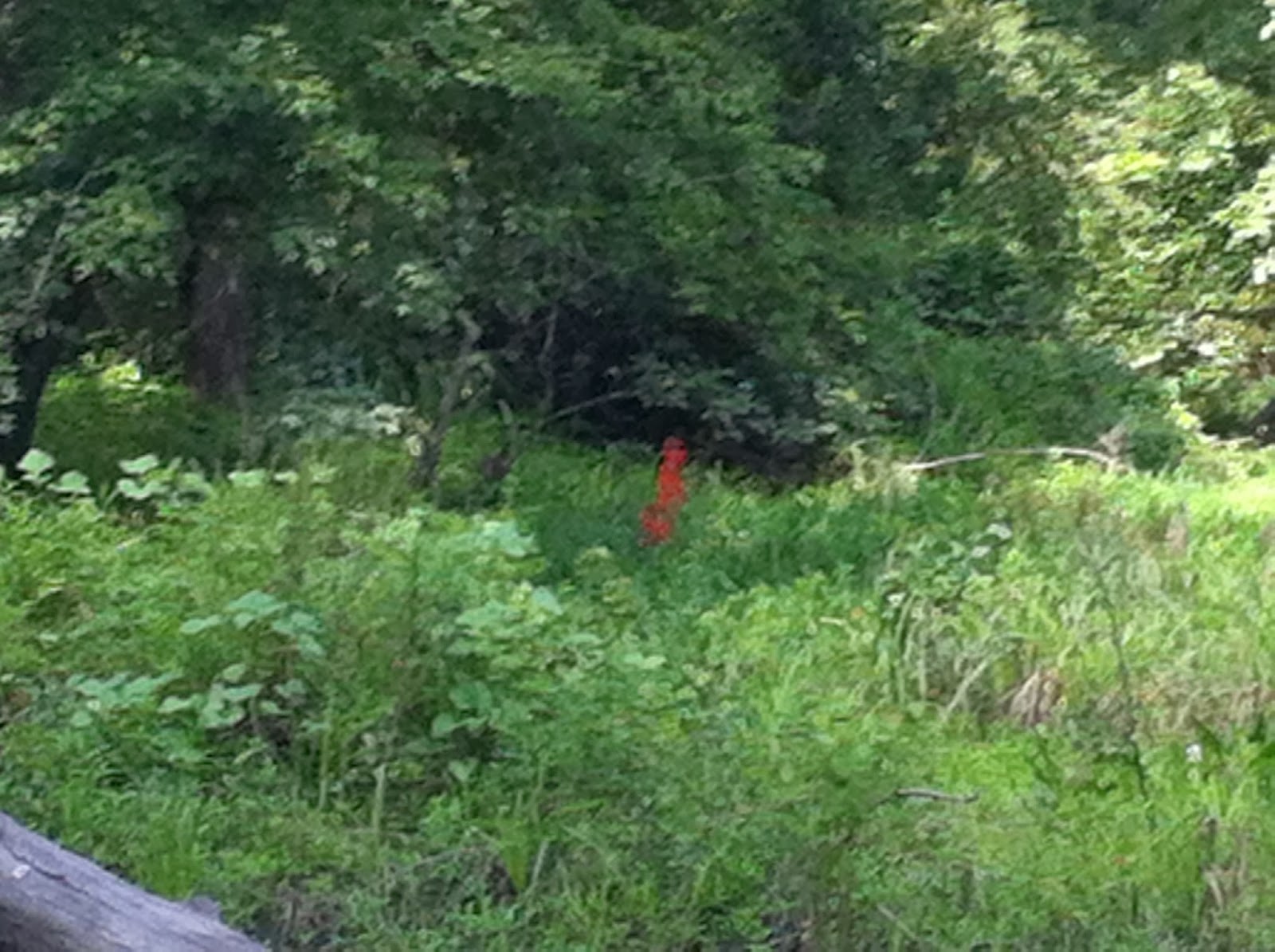
"Cardinal Flower"

am liking the pareidolia of
this painterly shot in Turners Falls, MA 

Cardinal flower is not typically in regular use in herbal medicine Lobelia inflata is. Lobelia cardinalis possesses less potency as an analgesic, antispasmodic, emetic and cartarrh with bronchial respiratory and lower digestive systems.

I took near where a camp of Native Americans...

from http://en.wikipedia.org/wiki/King_Philip's_War
"May 18, 1676, Captain William Turner of the Massachusetts Militia and a group of about 150 militia volunteers (mostly minimally trained farmers) attacked a large fishing camp of Native Americans at Peskeopscut on the Connecticut River (now called Turners Falls, Massachusetts). The colonists claimed they killed 100–200 Native Americans in retaliation for earlier Indian attacks against Deerfield and other colonist settlements and the colonial losses in the Battle of Bloody Brook. Turner and nearly 40 of the militia were killed during the return from the falls."

As it was at fishing camps just before sunrise the men were all out fishing. The camp of over 200 elders, women and children were slaughtered,was atop the cliffs that dropped down to the rapids of the river. Below the men listened to the screams.. These lands were Sacred as fishing and farming along the Connecticut. Healing intent with this photo is to send a message of recognition, understanding and consciousness into the Earth of the people...
~Love, Peace and CoCreativity~

Monday, June 24, 2013

Gathered Stinging Nettles Urtica dioica sp. on Solstice morning and here it is hanging briefly before I set in the darkness of a dry shed. In gathering I allowed it to sting me with its acidic virtues into a two day itch for my joints, bones and kidneys. The itch and swelling time can be an indication of ones' needs for the healing powers of this fine herb. I've had more intense reactions in previous years so I'm happily not scratching, grin...
The energetics of Summer Solstice and the perigee Full Moon in Capricorn instill me with Belief!, caring for others within the family circle and outward, and strengthening my own knees/needs...


One of my teachers and a good friend is Ryan Drum. Check out       http://www.ryandrum.com/wildcrafting.htm to read his articles on wildcrafting Stinging Nettles and other medicinals.

Thursday, April 25, 2013

Yellow Thistle Cirsium horridulum


This Yellow Thistle was in a colony of about 20 plants at the edge of an inland water salt marsh in Wilmington NC. The flower was 5" in diameter and the plant stood about 6' tall. The stalk was nearly 3" in diameter.

from http://herb.umd.umich.edu/herb/search.pl?searchstring=Cirsium
Yellow Thistle; Asteraceae
Seminole Other (Hunting & Fishing Item)
Plant used to make blowgun darts.
Sturtevant, William 1954 The Mikasuki Seminole: Medical Beliefs and Practices. Yale University, PhD Thesis (p. 507)

Like all Cirsium thistles the leaf (remove the spiney edges), stalk and 
root are edible and a Spring liver cleansing bitter like Dandelion. The Latin horridulum relates to flatulent farting, drawing our own conclusions a tonic for gaseous conditions of the liver and digestive organs perhaps...


Traditional ethical wildcrafting & foraging is a sustainable practice. One does not gather every thing in sight as that leads to wiped out colonies of plant life that continue to produce and sustain their population by their natural seeding and/or root growth cycles. The general ethical natural code, universal law, is to gather no more than 10% to 25% of any colony so in the following years there'll be more or at least a constant population. Birds and other animal and plant life are also dependent on these food sources. Consider that 4 separate people unknowing of the others gather 25% in one season can occur without conscientious and mindful practices. Please respect where you gather. Toxic areas next to highways, airports and railways are poor selections. Always ask permission of the landowner. They can often tell you if someone else is gathering on their land or that they depend on the harvesting of the plant life. Also consider plant species that are already threatened or endangered by over harvesting and not wildcraft or support any one who does harvest Echinacea sp., Goldenseal and American Ginseng. Check for other plants that are threatened in the area. Contact groups like American Herbalists Guild and United Plant Savers who are active networking communities and have access to to this knowledge. And foremost, offer thanks and gratitude to the plants, they appreciate that.

Saturday, February 23, 2013


Patterns of emerging greens out of the browns/reds of winter here in coastal SE North Carolina. These plants are here with/for us to cleanse our stuck and thickened blood and fat, stored initially for nourishment, that await lymphatic and blood rinsing of unprocessed wastes with the assistance of rains. This early Spring call with Earth and with our plant allies is eliminating and repurifying stagnant wastes from Earth as well as with our own bodies. It is an essential synchronicity of our wholeness with Earth and with the elements. Rich in minerals and vitamins for all who rely on Earth's Cornucopia of Plenty. With gently applied nurturing our existence smoothly flows with the seasons.
My understanding of many of the local greens is too limited for bioregional specificied recommendations with all the plants in the above photograph. Neither do I recommend working with these plants or with other cleansing tonifying herbs on your own without consulting an experienced practitioner.
The roots, greens and/or blossoms of plants we generally might consider during early Springtime lymphatic and blood cleansing worth considering in western traditions are Burdock (Gobo) Arctium lappa, Cleavers Galium aperine, Dandelion Tarraxacum off. (over 500 bioregional varieties depending on where in the world one lives), Plantain Plantago major & lanceolata, Red Clover Trifolium pratense and Yellow or Curly Dock Rumex crispus.
Green Blessings...


Sunday, September 9, 2012

this 4" x 6 1/2" untitled landscape was done with heated Stockmar beeswax & natural pigment on reconstituted brown paper grocery bag with inclusion of Chamomile Matricaria recutita flowers from the tiered herb garden I designed & installed at the then Crystal Ledge property in Voorheesville, NY in 1991.

the cradled backing for panel support is Phragmites spp. I foraged locally in Bethlehem, NY 
 with signature & date visable..


Wednesday, February 22, 2012

Chickweed (Stellaria media)

Chickweed is a very tasty nourishing spring herb addition to salads and snacking on a forage in your garden and in the meadow.
Stellarria, after its' star like flower, enriching the fallow raised bed.
There's Blessed Thistle Centaurea benedicta in there also doing its part to heal and enrich the soil
along with other plant, animal and spirit soil essentials.

One can smell and feel the Spring cleansing, rebirthing energetics of Chickweed as it nears the taste buds!
As always try to be very select in wildcrafting in not picking more than 25% of existing plant colonies, do not gather close (if possible further than 100 yards away from) to highway's fumes or power lines, ask permission from landowners and the plant colony, and give thanks to those people and plants for their symbiotic gift to you/us.

"Chickweed fresh herb (Stellaria media) is a mild food herb that is diuretic, anti-inflammatory and a vulnerary. Internally it is used for urinary irritation including interstitial cystitis as well as gastritis, gastric and duodenal ulcers. Topically Chickweed is utilized for inflammatory skin and mucous membrane conditions such as erosion of the cervix and vulvodynia.
Topical use - Fresh poultice of the crushed herb as needed
Extract - 60 -100 drops QID" 
© Herbal Therapeutics, 2003 8th edition by David Winston, Herbalist AHG & Ethnobotanist, p. 71

from http://www.stevenfoster.com

Chickweed Stellaria media          ©Steven Foster Photography

Friday, December 9, 2011

Brownies

Brownies                                digital                             ©Greg Patch

Friday, September 16, 2011

nuts, seeds, waves and grid

nuts, seeds, waves and grid          11" x 24"          mixed media           

Fall is approaching. The nuts and seeds are riding the energetic waves of the nature grid to our storage box grids. They all help to nourish & stabilize us (hu womyn/man), the animals, the earth and the elements with nutrients and a sense of interdependence.
In this {peace} acorns Quercus germinata , Sweetgum Liquidambar styraciflua fruit, Pecans Carya illinoinensis, beeswax, earth pigments, cardboard & Khadi papers make for the mix of mediums, streams of consciousness, and the powerful thread connecting all...

Saturday, August 20, 2011

seeking bamboo


on a tip from a Tidal Creek Coop worker I found this little grove of bamboo and will go back tomorrow to ask permission from the people who own the land to cut bamboo to hang ...a pro(c)(g)ressing transformation...

Tuesday, June 28, 2011

Curry, Curry and Curry

Curry, Curry & Curry and Coriander and Cilantro

The more commonly available Curry powder in US of A stores is a combination of several herbs. Turmeric root Curcuma longa, a strong dye, Coriander seed Coriandrum sativum (Cilantro is the leaf of Coriandrum sativum) and Cumin seed  are in it and typically give it the color we are familiar with. Globally, regional variations on other ingredients occur. http://en.wikipedia.org/wiki/Curry

Curry powder


Curry, the plant Helichrysum italicum, as an herb is available usually in specialty shops and herbal supply sources
http://en.wikipedia.org/wiki/Helichrysum_italicum

Curry plant


Curry Murraya koenigii is a tree.
http://en.wikipedia.org/wiki/Curry_Tree
a grid of the Curry Tree, nice pic from public domain

Tuesday, May 3, 2011

Pineapple Guava Acca spp.

Pineapple Guava Acca Sellowiana                         ©Greg Patch

from http://en.wikipedia.org/wiki/Acca_sellowiana

Acca sellowiana, a species of flowering plant in the myrtle family, Myrtaceae, is native to the highlands of southern BrazilColombia,Uruguay, and northern Argentina.[1] Common names include feijoa (pronounced /feɪˈʒoʊ.ə//feɪˈdʒoʊ.ə/,[2] or /feɪˈhoʊ.ə/[3]pineapple guava and guavasteen. It is an evergreenperennial shrub or small tree, 1–7 metres (3.3–23 ft) in height, widely cultivated as a garden plant and fruiting tree. The German botanist Otto Karl Berg named feijoa after João da Silva Feijó, a Portuguese botanist born in the colony of Brazil.


Since moving I've been watching the progress of this shrub blooming in my back yard by my kitchen door  i want to thank the folks at "the arboretum" here in New Hanover County, Wilmington NC. in helping me identify Acca spp. today. They are part of the NC Cooperative Extension. Wherever you live in the states Cooperative Extension is always helpful with plant ids. They are also part of NC A & T State University. 


Both fruit and flower are edibles. Am sure leaf, bark and root are medicinals in their native lands. I do not recommend ingesting it here unless your shrub grows at least 100 feet from roads, house eaves and other toxic areas, and grows in organic soils. I taste sampled the flower. It had a hint of pineapple flavor, not at all sweet, kinda bland... Taste is very important in iding and using herbs in diet and medicinally. With the plants one tastes a very minute amount to avoid unwanted results. It is an art, and takes practice. Before sampling plant materials there are other ways one can "sense" ingestability and energetics of plant materials. That is an art as well. Logically, never eat anything unless you know what it is!

Monday, March 28, 2011

MF Cardamone


http://mfcardamone.com/


MF Cardamone's mixed media works on paper whimsically record the life histories of plants throughout the world. Her plant specimens are collected and combined with images and words that playfully modernize the traditions of specimen mounting and botanical illustration. The results are complex visual narratives that reveal the science, history, and beauty of their subjects. Original pieces are produced in small editions and printed on 100% rag watercolor paper using archival inks and individually embellished by hand.
Shortly after completing the Barnes Foundation Arboretum School program, she started designing her native Pennsylvania wildlife habitat garden. While researching and collecting native plants for the garden, she became fascinated by their life histories and medicinal uses. "I wanted to document the information and create work that would be both entertaining and educational". Her inspiration and influences are varied and combine a lot of different interests such as: Medieval Herbals and manuscripts, ecology, folklore, ethnic and vintage designs, Traditional Chinese Medicine, Pop Art and Surrealism.
"I’m fascinated by plants and the relationship we have with nature. I'm in awe of their mystery, beauty and the power they have to sustain and heal."

Thursday, January 27, 2011

Paul Stamets; Mycologist (mushroom-ologist)

http://www.fungi.com/index.html


Fungi Perfecti (fun ji' per fect' i)
The unofficial name for the Subdivision hosting what we call mushrooms. Mushrooms are fleshy fungi that reproduce through the sexual matings of germinated spores.
Fungi Perfecti® is a family-owned, environmentally friendly company specializing in using gourmet and medicinal mushrooms to improve the health of the planet and its people. Founded by mycologist and author Paul Stamets, we are leaders in a new wave of technologies harnessing the inherent power of mushrooms and fungal mycelium worldwide. Fungi Perfecti® is Certified Organic by the Washington State Department of Agriculture. In business since 1980, we offer an ever-expanding product line for the mushroom enthusiast.

other sources of information on Paul Stamets work:
http://en.wikipedia.org/wiki/Paul_Stamets
www.facebook.com/PaulStamets
www.ted.com/speakers/paul_stamets.html
http://bit.ly/eIul4v

Paul Stamets will give the keynote address at the 10th International Herb Symposium being held at Wheaton College in Norton, MA this summer June 24th - 26th 2011.
www.internationalherbsymposium.com
sage@sagemountain.com 
www.unitedplantsavers.org

Wednesday, January 19, 2011

beginning research (sketches) on Lotus Nelumbian spp.


for use in future work begins with looking at Lotus, images of Lotus, science/metaphysics of Lotus, saying the word Lotus in a crowded room...  being with Lotus...

Tuesday, December 21, 2010

enJoy the Solstice!

http://www.hort.purdue.edu/newcrop/morton/pomegranate.html

Plate XLIX: POMEGRANATE, Punica granatum


Botanical.com - A Modern Herbal, by Mrs. M. Grieve

Pomegranate

Botanical: Punica granatum (LINN.)
Family: N.O. Lythraceae

---Synonyms---Grenadier. Cortex granati. Ecorce de Granade. Granatwurzelrinde. Melogranato. Malicorio. Scorzo del Melogranati. Cortezade Granada.
---Parts Used---The root, bark, the fruits, the rind of the fruit, the flowers.
---Habitat---Western Asia. Now grows widely in Mediterranean countries, China and Japan.

---History---The Latin name of the tree was Malus punica, or Punicum Malum, the Lybian or Carthaginian apple; while the name of granatum was bestowed on account of its many seeds. Having no close relations, the tree has been placed by various authorities in different orders, some giving it an order of its own, Granateae.---Description---It is a small tree, not more than 15 feet high, with pale, brownish bark. The buds and young shoots are red, the leaves opposite, lanceolate, entire, thick, glossy and almost evergreen. The flowers are large and solitary, the crimson petals alternating with the lobes of the calyx. The fruit is the size of an orange, having a thick, reddish-yellow rind, an acid pulp, and large quantities of seeds.
The dried root bark is found in quills 3 to 4 inches long. It is yellowish-grey and wrinkled outside, the inner bark being smooth and yellow. It has a short fracture, little odour and a slightly astringent taste.
The rind of the fruit is in curved, brittle fragments, rough and yellowish-brown outside, paler and pitted within. It is called Malicorium.
The fruit is used for dessert, and in the East the juice is included in cooling drinks.
The flowers yield a red dye, and with leaves and seeds were used by the Ancients as astringent medicines and to remove worms.
The Pomegranate is mentioned in the Papyrus Ebers.
It is still used by the Jews in some ceremonials, and as a design has been used in architecture and needlework from the earliest times. It formed part of the decoration of the pillars of King Solomon's Temple, and was embroidered on the hem of the High-Priest's ephod.
There are three kinds of Pomegranates: one very sour, the juice of which is used instead of verjuice, or unripe grape juice; the other two moderately sweet or very sweet. These are (in Syria) eaten as dessert after being cut open, seeded, strewn with sugar and sprinkled with rosewater. A wine is extracted from the fruits, and the seeds are used in syrups and conserves.
The bark is used in tanning and dyeing giving the yellow hue to Morocco leather.
The barks of three wild Pomegranates are said to be used in Java: the red-flowered merah, the white-flowered poetih, and the black-flowered hitam.
[Top]
---Constituents---The chief constituent of the bark (about 22 per cent) is called punicotannic acid. It also contains gallic acid, mannite, and four alkaloids, Pelletierine, Methyl-Pelletierine, Pseudo-Pelletierine, and IsoPelletierine.
The liquid pelletierine boils at 125 degrees C., and is soluble in water, alcohol, ether and chloroform.
The drug probably deteriorates with age.
The rind contains tannic acid, sugar and gum.
Pelletierine Tannate is a mixture of the tannates of the alkaloids obtained from the bark of the root and stem, and represents the taenicidal properties.
---Medicinal Action and Uses---The seeds are demulcent. The fruit is a mild astringent and refrigerant in some fevers, and especially in biliousness, and the bark is used to remove tapeworm.
In India the rind is used in diarrhoea and chronic dysentery, often combined with opium.
It is used as an injection in leucorrhoea, as a gargle in sore throat in its early stages, and in powder for intermittent fevers. The flowers have similar properties.
As a taenicide a decoction of the bark may be made by boiling down to a pint 2 OZ. of bark that has been macerated in spirits of water for twenty-four hours, and given in wineglassful doses. It often causes nausea and vomiting, and possibly purging. It should be preceded by strict dieting and followed by an enema or castor oil if required.It may be necessary to repeat the dose for several days.
A hypodermic injection of the alkaloids may produce vertigo, muscular weakness and sometimes double vision.
The root-bark was recommended as a vermifuge by Celsus, Dioscorides and Pliny. It may be used fresh or dried.
---Dosages---Of rind and flowers in powder, 20 to 30 grains. Of pelletierine tannate, 3 to 5 grains. Of rind, 1 to 2 drachms. Fluid extract, root-bark, 1/4 to 2 drachms. Decoction, B.P., 1/2 to 2 OZ. Of decoction of 4 OZ. of bark to 20 of water, 1/2 a fluid ounce.
---Adulterations---The bitter but non-astringent barks of Barberry and Box (Boxux sempervirens). Their infusion does not produce the deep blue precipitate with a persalt of iron.
Pinana is a dwarf variety naturalized in the West Indies.

Saturday, November 6, 2010

Shrimpers

              Shrimpers                                                              ©Greg Patch


Seasonally, in the cooling waters of Fall, family owned ventures of Shrimpers cruise the coast here off Topsail Island, NC. The squeeze they feel from the current general economic status along with pressures from large corporate businesses, farm raised shrimp and environmental toxins has severely diminished their numbers from less than a decade ago.

Friday, October 22, 2010

The Hunter's Full Moon...

...is at 29˚ 33" Aries today, 10/22/10, at 7:38 PM. Has your hunting been productive over the last 28 days?

Thursday, October 21, 2010

poetry


Today I spotted a male Loon in my back yard, the Atlantic Ocean. It left before I could grab my camera. In a flash. Reminding me to post this poem I wrote a few years ago before migrating south for the winter myself. Now here, I have the migrating Loon to let me know cooler weather is slowly/in a flash moving down the globe with each setting Sun. I will get time to photo the male Loon as he hunts/forages his winter diet and include more on these beautiful ancient creatures migrating story. It remembers us more. In the meantime...


flash, flash

troubles seem so far away,
lifetimes come streaming by.
this moment, recorded in nanoseconds,
in a sparkling flash, flash and back again.
the details of the flash are succinct, so real, and as if days, years, lifetimes,
of that moment
were a living part of its reality.
seldom do I remember such a fall,
the leaves are in full blossom,
a quiet buzz of colors exploding
out of the blue skies.
I crave.
In one sheet of hard, cold
wind and rain
lay the skeletal limbs of
maple, oak, beech, and
horse chestnut
on yellow violet skies.
In a week I’ll fly to the sky
with the geese for warmer grounds,
in a flash.

©Greg Patch 2005