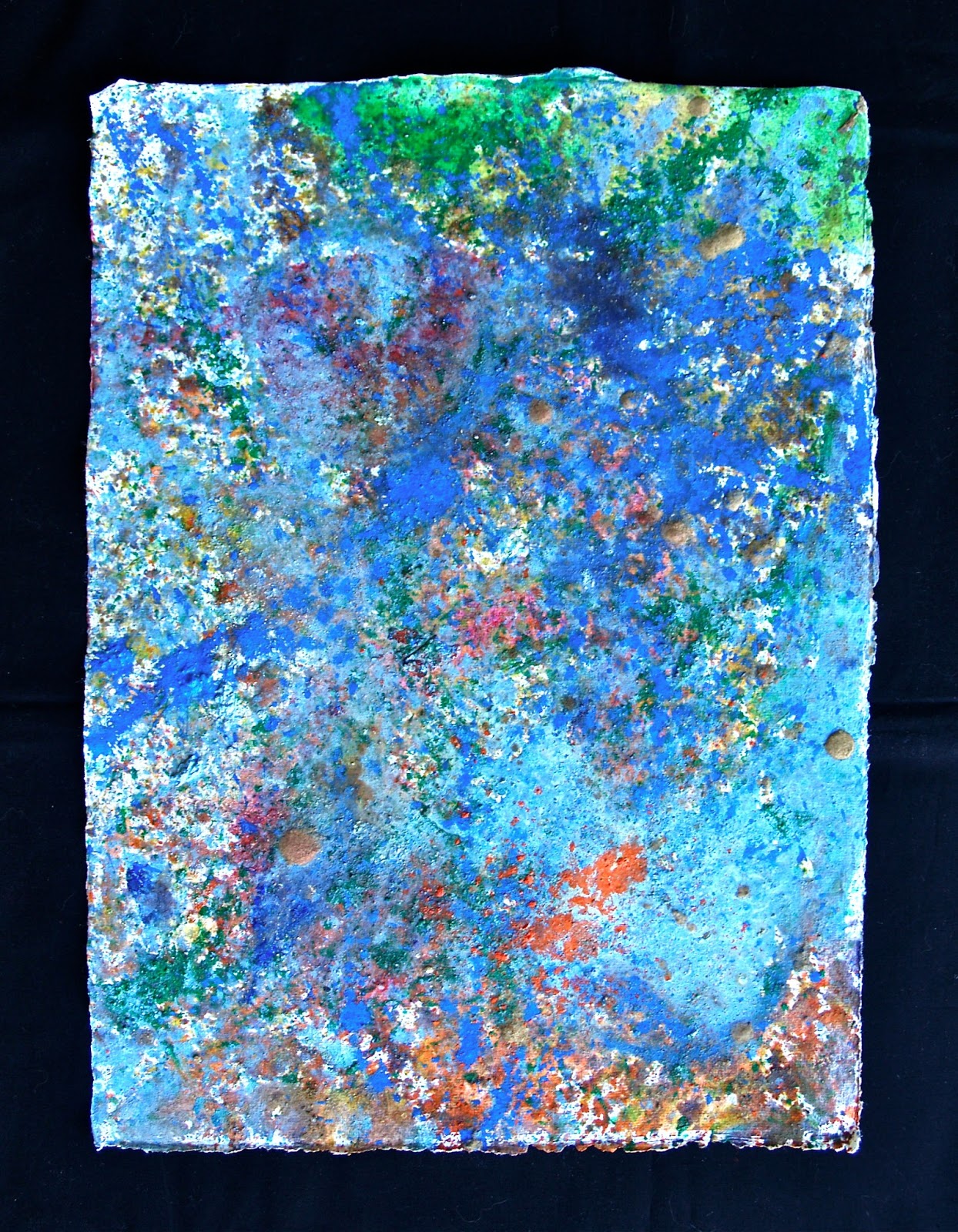
I opened 5' x 10' "Webh Celebration", 2009 from within its storage tube for & with Green Art Studio
~Hello Universe~
from my June 15th, 2010 post http://gregpatch.blogspot.com/2010/06/webh-celebration.html
The concept for the “Webh Series” originated as a continuation of the “Chakra Rising Wave Series.” The words wave, weave, and web are derived from the Proto-Indo-European root word webh. Within a template symbol, Webh employs three basic grays; red/green, orange/blue, and yellow/violet. A symbolic representation of the webh on seven color fields creates a whole having 21 saparate panels. The textured pattern of the Lokta/Nepal paper augments the overall pattern within the panels by solidifying its foundation. "Webh Celebration" is 5' x 10'.
Webh is symbolic of the internal and external relationships between opposing concepts of us and them. Symbolic levels also include earth and water, fire and air, matter and non matter, imbalance and wellbeing, inhaling and exhaling, and di and da. It is the system expressed as an interconnected whole.
In art there has traditionally been realism and abstraction. Artists are beginning to bridge this gap and to recognize and formalize a wholistic picture: real and abstract. Webh maintains the individuality and quality of each within a wholistic relationship, while creating a separate entity within the unique character of each piece. There is a quantum moment within a process when these merged perspectives bring forth the world in its totality. The work becomes a self portrait as well as a portrait of a culture. Artists are coupling their "new"*understanding of 'wholeness' to the greater community. In these paintings this pattern appears at a level where old and new meet, link, renew, and weave together again. Many artists today are reconnecting to our roots and traditional cultures. This work can be symbolic of the basis of life, DNA, the Caduceus. The webh is infinite.
[Footnote this] “New,” used above, is in quotes because this concept of wholeness is not new. Many older civilizations understood this duality. The Aborigine, Native American, African traditionals, Celtic, Ayurvedic, European, Chinese and Asian peoples possessed this understanding of a whole, interelated and interdependent conceptual framework of our inner and outer world.



.JPG)